Compare · Cortechs.ai NeuroQuant
NeuroQuant Alternatives and Cortechs.ai Pricing Compared
The short answer
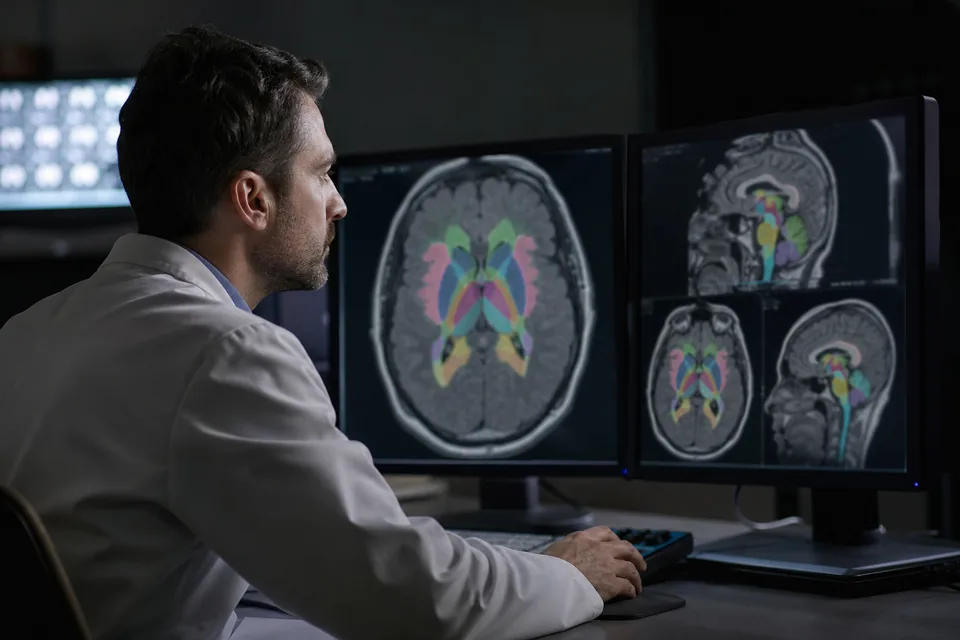
NeuroQuant is brain MRI volumetrics software from Cortechs.ai in San Diego, FDA-cleared since August 2006. It measures structures like the hippocampus against an age-matched normative database. Federal buyers have placed 20 orders naming it, worth $5.9 million. The cleared alternatives are icometrix icobrain (now GE HealthCare), Quantib ND, Combinostics cNeuro, Neurophet AQUA and Neuroreader.
Search for NeuroQuant and almost everything you get is either a patient looking for an MRI center that offers it or a research paper comparing its numbers with another package. Neither helps the person who has to sign the license. That is usually the operations lead at an outpatient imaging center adding volumetrics to brain MRI, a neuroradiology group asked by referring neurologists for Alzheimer's and MS reports, or a VA or military hospital renewing an annual contract.
This page puts the parts that matter to that buyer in one place. Every brain volumetrics product with a current FDA clearance, the ownership changes that happened in the last year (GE HealthCare bought icometrix in November 2025, RadNet already owns Quantib), and the only public price record for NeuroQuant, which is 20 federal orders from 2011 to 2026. Cortechs.ai publishes no price list, so those orders are the one checkable benchmark you can bring to a quote.
One more thing worth knowing before you compare: the packages do not produce identical numbers. Published studies comparing NeuroQuant with other tools on the same patients found regional volumes that differ by package. If you switch, plan a fresh baseline for patients you follow over time.
Worklist
Structured report
DraftRun the assistant to draft this report for review.
Decision support. The radiologist reviews and signs every study.
Decision support for qualified clinicians. Radiological.ai does not provide a diagnosis and is not a substitute for professional judgment.
Flag · prioritize · draft · you review and sign
Cortechs.ai sells quantitative neuroimaging: segmented brain volumes compared with a normative database, lesion counts for MS and tumor follow-up, and now PET quantification. Radiological.ai does not measure brain volumes against norms. It is an assistant across the whole read: it flags suspected findings on X-ray, CT and MRI, prioritizes the worklist and drafts the structured report. You would replace NeuroQuant with another volumetrics package. You would add us beside it.
Side by side
NeuroQuant against the other FDA-cleared brain volumetrics software
Every product below holds an FDA 510(k) for automated quantification of brain MRI. Dates are FDA decision dates, not our benchmark.
| What to compare | Cortechs.ai NeuroQuant | Other cleared brain volumetrics |
|---|---|---|
| Who owns it | Cortechs.ai, formerly CorTechs Labs, a privately held San Diego company led by CEO Kyle Frye. It closed a Series C led by VILAS Ventures in November 2024. | icobrain: GE HealthCare since November 2025. Quantib ND: RadNet, through its DeepHealth unit. cNeuro: Combinostics, Finland. AQUA: Neurophet, South Korea. Neuroreader: Brainreader, Denmark. |
| First clearance | K061855, August 10, 2006, the earliest of the group by about a decade. | Neuroreader K140828 (2015), Quantib Brain K153351 (2016), icobrain K161148 (2016), cNeuro cMRI K171328 (2018), Neurophet AQUA K220437 (2023). |
| Recent clearances | NeuroQuant K170981 (2017) and K241098 (August 2024), OnQ Neuro K210831 (2021), NeuroQuant PET K261916 (August 12, 2026). | icobrain aria K240712 (November 2024), Quantib Brain WMH K251527 (September 2025), Neurophet AQUA AD Plus K252496 (January 2026) and AQUA K261273 (May 2026). |
| Clinical coverage | Dementia volumetrics, MS lesion counts and change over time, brain tumor follow-up, PET quantification. | icobrain covers MS, dementia, TBI and ARIA monitoring for anti-amyloid therapy. Quantib ND covers atrophy and white matter lesions. cNeuro adds PET and DaT modules. |
| How it reaches US sites | Directly, on Philips Advanced Visualization Workspace, through the Siemens Healthineers Digital Marketplace (March 2026) and into Viz.ai for MS (July 2026). Federal orders mostly go through resellers. | icobrain is being integrated with GE HealthCare MRI systems. Quantib ND comes through DeepHealth. The others sell directly or through AI marketplaces. |
| Published price | None. The public record is 20 federal orders, including an annual unlimited license at one VA medical center for $33,988. | We found no published list price for any of them. |
| Where it wins | Installed base and familiarity. Referring neurologists often ask for NeuroQuant by name, and it is the package most research comparisons use as the reference. | icobrain: ARIA grading for Leqembi and Kisunla patients and MS change detection. Quantib ND: a fit for RadNet and DeepHealth sites. cNeuro: multimodal dementia work. |
| Switching cost | Staying keeps your baselines comparable and your referrers' report format. | Real. Volumes differ between packages, so follow-up patients need a new baseline, and referring neurologists have to learn a new report. |
FDA data is from the openFDA 510(k) database, searched by applicant on October 9, 2026. Ownership facts come from GE HealthCare SEC filings (icometrix, closed November 7, 2025) and company announcements. Federal data is from USAspending.gov.
What the public record shows
What 20 federal orders say NeuroQuant costs
Cortechs.ai publishes no price. Federal buyers have bought NeuroQuant 20 times since 2011, almost always through a reseller, and every one of those orders names the product.
| Measure | Figure | What it tells a buyer |
|---|---|---|
| All orders naming NeuroQuant | 20 orders, $5,915,807, August 2011 to September 2026 | A steady federal buyer base for 15 years. The median priced order is $72,370. |
| Military hospitals | 6 Defense orders, $4,224,195, 2011 to 2015, including $2,950,330 for seven military treatment facilities in 2015 | Bought as software bundles per hospital, $249,900 each at Fort Hood and Fort Campbell in 2014, during the traumatic brain injury buildout. |
| VA medical centers | 14 orders, $1,691,612, median $64,606 | The recurring shape: an annual license or service agreement per facility. |
| Annual unlimited license | $33,988 a year at one VA medical center, 2018 and 2019 | The clearest single-site figure on record: unlimited studies for one facility for a year. |
| Recent renewals | $69,300 service agreement and license, July 2025 and again September 2026; $64,606 in February 2026 | Current single-site renewals run in the tens of thousands of dollars a year, not per study. |
Source: USAspending.gov prime awards, award types A to D, fiscal 2008 to 2026, keyword NEUROQUANT, pulled October 9, 2026. All 20 rows read by hand; one $0 order is counted but left out of the median. A recipient search for CORTECHS mostly returns CORTECHS, INC., an unrelated software testing contractor, and was discarded except two small 2010 and 2012 VA analysis orders to CORTECHS LABS.
Side by side
Radiological.ai vs Cortechs.ai NeuroQuant, honestly
A fair look at what each does well. Both are capable tools. Here is where they differ.
| What matters | Radiological.ai | Cortechs.ai NeuroQuant |
|---|---|---|
| What you are buying | Software that flags suspected findings across the read, prioritizes the worklist and drafts the structured report. | Segmented brain volumes and lesion measurements compared with an age-matched normative database, delivered as a report. |
| Studies covered | X-ray, CT and MRI, under one subscription. | Brain MRI, plus PET in the newest module. |
| Unit of cost | Per reading radiologist, published: $399 a month on the Practice plan or $199 a month billed annually, and $598 a month on the Group plan or $299 a month billed annually. | Unpublished. Federal orders show annual site licenses and service agreements, often bought through a reseller. |
| Billing for the patient | Nothing separate to bill. It shortens the work behind codes you already bill. | Category III CPT codes 0865T and 0866T since January 2024, paid payer by payer. |
| Who signs the report | The radiologist. The assistant never signs anything. | The radiologist, who attaches or references the volumetric report. |
| Best suited for | Practices that want help across the whole worklist, not one measurement. | Imaging centers and neurology practices whose referrers want quantified atrophy and lesion change. |
Comparison reflects general, publicly understood positioning. Capabilities change, so check each product for the latest.
This page covers one quantitative neuroimaging vendor. If icobrain is the product you are weighing NeuroQuant against, icobrain alternatives after the GE HealthCare deal covers ARIA monitoring and the renewal questions for GE. For acute neuro, where the buyer is a stroke program rather than an outpatient center, the best stroke AI software for hospitals compares RapidAI and Viz.ai, and RapidAI alternatives covers Brainomix and the rest of the triage field.
If cNeuro is the incumbent, Combinostics cNeuro alternatives after the SyntheticMR deal covers its clearances, the ARIA gap and what to ask at renewal.
For a category view of what AI does on MRI and the other modalities, AI medical imaging software lays out where detection, quantification and reporting assistance fit, and the best AI radiology software roundup compares the vendors side by side.
If the question is cost across vendors, how much radiology AI costs compares per-study and subscription pricing, and the pricing page lists the per-radiologist plans.
Why groups pick Radiological.ai
One assistant across the whole read
Price it as a site license
The federal record shows annual licenses per facility, $33,988 for unlimited use at one VA center and about $69,000 for a recent service agreement. If your quote is per study, convert it at your real brain MRI volume and compare.
Ask how you will bill it
CPT 0865T and 0866T are Category III codes, so each payer decides. Ask your top three commercial payers what they pay before you count the analysis as revenue rather than a cost of keeping referrers.
Plan the baseline before you switch
Volumetric packages disagree on regional volumes. If you move from NeuroQuant to icobrain or Quantib, rerun recent baselines for patients in active follow-up, and tell referrers when the report format changes.
Separate quantification from capacity
Volumetrics answers one question about one study type. If the problem is how many studies each radiologist gets through, an assistant that orders the worklist and drafts the report addresses that, and it runs beside NeuroQuant.
Good questions
Cortechs.ai NeuroQuant vs Radiological.ai, answered
More comparisons
See how Radiological.ai compares
Aidoc alternative
One assistant across the whole read, not acute triage alone.
vs Rad AIRad AI alternative
Drafting plus flagging and triage, in one assistant.
vs DeepHealthDeepHealth alternative
Reporting AI without buying it from a competitor.
vs Fluency for ImagingPowerScribe vs Fluency for Imaging
The two reporting platforms most US groups actually shortlist.
vs Annalise.aiAnnalise.ai alternative
Finding flags plus triage and drafting, together.
vs Nuance PowerScribeNuance PowerScribe alternative
More than dictation: flagging, triage and drafting.
vs Qure.aiQure.ai alternative
Flags plus triage and drafting, in one assistant.
vs Viz.aiViz.ai alternative
Beyond acute stroke triage, across the whole read.
vs Nuance DAXNuance DAX alternative
Built for the read, not for the patient conversation.
vs LunitLunit alternative
One assistant across the whole read, not detection on two modalities.
vs GleamerGleamer alternative
One assistant across X-ray, CT and MRI, not a suite of per-exam detectors.
vs PowerScribe OnePowerScribe One vs 360
What actually changes in the cloud move, and the third option.
vs Sirona MedicalSirona Medical alternative
Add the assistant to the PACS you already run, without replacing the stack.
vs New LanternNew Lantern alternative
AI drafting and triage on the PACS you keep, not a new platform.
vs RapidAIRapidAI alternative
Past the stroke pathway, across the whole reading list.
vs Dragon Medical OneDragon Medical One pricing
Microsoft publishes no price. Here are 25 real federal contracts that do.
vs PowerScribePowerScribe pricing
No list price exists. Here are the only verifiable numbers that do.
vs PowerScribePowerScribe templates
What AutoText actually is, how to get yours out, and what survives a migration.
vs RADPAIR and PowerScribeRadPair vs PowerScribe
Three ways to write the report, compared on what each one actually replaces.
vs Aidoc and Viz.aiAidoc vs Viz.ai
Three acute triage platforms, compared on what they were each built to do.
vs vRad (Virtual Radiologic)vRad alternative
vRad publishes no rate card. 357 federal contract awards do.
vs ONRADONRAD alternative
ONRAD publishes no rate card. 80 federal contract awards do.
vs Real RadiologyReal Radiology alternative
Real Radiology publishes no rate card. 41 Army and VA contract awards do.
vs Experity TeleradiologyExperity Teleradiology alternative
The urgent care reading service that started as one Scottsdale radiologist and now sits inside an EMR company.
vs Sectra PACSSectra PACS alternative
The PACS that keeps winning satisfaction surveys, sold as a cloud subscription with no public price.
vs Visage PACSVisage PACS alternative
The fastest-growing enterprise viewer in US radiology, priced per transaction and disclosed deal by deal.
vs Intelerad PACSIntelerad PACS alternative
The teleradiology favorite, now a GE HealthCare business, with a renewal conversation that just changed.
vs Exa PACSExa PACS alternative
Often sold alongside a Konica X-ray room, with a thin public record you should fill in before you sign.
vs GE Centricity PACSGE Centricity PACS alternative
An aging install base, three GE PACS lines under one owner, and a recall record you should read before the renewal.
vs Agfa PACSAgfa PACS alternative
A Best in KLAS platform, a federal record over $300 million, and an IMPAX install base being moved to the cloud.
vs McKesson PACSMcKesson PACS alternative
A Horizon Medical Imaging install base now owned by Optum, a $98 million federal record and a cloud PACS sold per study.
vs Mach7Mach7 alternative
A Vermont-run, ASX-listed enterprise imaging vendor with a new CEO, falling revenue and a seat on the VA teleradiology PACS.
vs iCADiCAD ProFound AI alternative
The first FDA-cleared AI for breast tomosynthesis, now owned by RadNet, the largest operator of US outpatient imaging centers.
vs ScreenPoint TransparaTranspara alternative
Dutch mammography AI sold in the US through Siemens Healthineers and Fujifilm units, with the strongest trial record in the category.
vs Avicenna.AI CINAAvicenna AI alternative
CT triage for stroke, pulmonary embolism and spine fractures, usually bought inside a scanner or platform vendor's bundle.
vs VIDIStarVIDIStar alternative
A Greenville cardiology PACS bought by Hitachi in 2018, inherited by Fujifilm in 2021 and sold today as Synapse Select.
vs Subtle MedicalSubtle Medical alternative
Two vendor-neutral MRI acceleration products, four scanner makers with their own, and the FDA and federal purchase records behind each.
From the blog: what the PowerScribe 360 end of life means for radiology groups, how much radiology AI costs, and the full comparison of the best AI radiology software in 2026.
See how Radiological.ai reads alongside your group
One assistant that flags suspected findings, prioritizes the worklist, and drafts the structured report on X-ray, CT and MRI. You review and sign every study.
Decision support for qualified clinicians. Radiological.ai does not provide a diagnosis and is not a substitute for professional medical judgment.