Combinostics cNeuro Alternatives After the SyntheticMR Deal
SyntheticMR bought Combinostics for EUR 4.3 million in January 2025 and its US sales have since fallen. We compare cNeuro with NeuroQuant, icobrain and DeepHealth Brain on FDA clearances, ARIA monitoring, price evidence and switching cost, with the questions to ask before you renew.
By the Radiological.ai team
October 2026 · 7 min read
Worklist
Structured report
DraftRun the assistant to draft this report for review.
Decision support. The radiologist reviews and signs every study.
Decision support for qualified clinicians. Radiological.ai does not provide a diagnosis and is not a substitute for professional judgment.
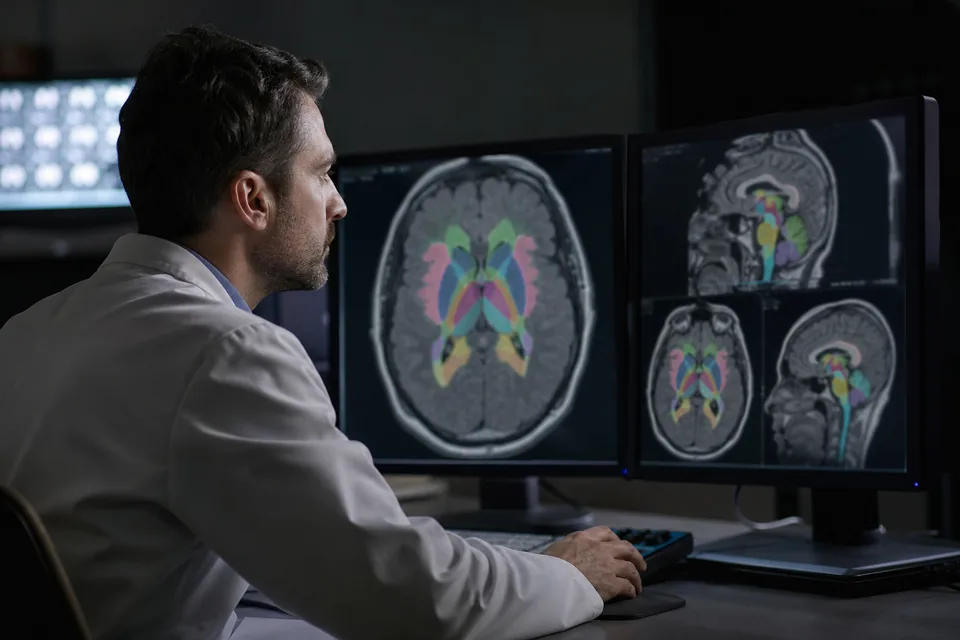
The short answer: cNeuro is brain imaging quantification software from Combinostics, a Finnish company that SyntheticMR, the Swedish maker of SyMRI, bought for EUR 4.3 million in a deal that closed on January 2, 2025. Its cMRI module measures brain volumes and lesions on MRI against a normative database, and it holds three FDA clearances. The FDA-cleared alternatives are Cortechs.ai NeuroQuant, icometrix icobrain (now GE HealthCare), DeepHealth Brain (formerly Quantib), Neurophet AQUA and Neuroreader. The deciding questions are whether you monitor anti-amyloid patients, which platform you buy AI through, and how much you trust a vendor whose US sales are shrinking.
This page is for whoever owns the cNeuro contract: the operations lead at an outpatient imaging center, a neuroradiology group reporting for a memory or MS clinic, or a hospital imaging director who got cNeuro through TeraRecon, Sectra or deepc and now has a renewal on the desk. Search for Combinostics or cNeuro today and you get the company site, the 2019 funding announcement and Swedish investor releases. Nothing compares cNeuro with the products you would actually replace it with, so we put the clearance record, the deal facts and the switching questions on one page.
Clearances come from the openFDA 510(k) database, searched by applicant on October 12, 2026. Deal terms and sales figures come from SyntheticMR's own press releases and its 2025 year-end and Q2 2026 reports. Federal figures are from USAspending.gov, award types A to D, fiscal 2008 to 2026.
What changed when SyntheticMR bought Combinostics?
SyntheticMR announced the deal on November 28, 2024, shareholders approved it at an extraordinary general meeting on December 17, and it closed on January 2, 2025. The price was EUR 4.3 million for all of Combinostics Oy: about EUR 3.93 million in cash, with EUR 0.86 million held in escrow for a year, and the rest through a promissory note set against convertibles. SyntheticMR is headquartered in Linköping, Sweden, and listed on the Spotlight Stock Market in Stockholm. In January 2026 it said the integration was finished and the two companies now run as one organization, with cNeuro cMRI sold alongside SyMRI.
The numbers since then cut both ways. Combinostics revenue grew 41% in 2025 to SEK 12.9 million, and cNeuro sales rose 63% in the second quarter of 2026. But the same reports say the US business developed weaker than expected, US sales fell to SEK 4.8 million from SEK 6.1 million in the first half of 2026, US leadership changed, and the group CEO is personally overseeing the US team. SyntheticMR also ran a rights issue in early 2026 to fund the business.
For a US buyer that means three practical things. Your support relationship now runs through a small Swedish public company whose US team is being rebuilt, so ask who your named contact is and where they sit. Your counterparty may have changed, and a change of control often triggers an assignment clause and a new business associate agreement. And the roadmap is being shaped around SyMRI plus cMRI bundles (the company sells a SyMRI Neuro+ package to about ten customers), which matters if you do not own SyMRI.
What cNeuro covers, module by module
| Module | What it does | US clearance |
|---|---|---|
| cMRI | Brain MRI volumetry across 133 regions against a normative database, plus T1 and FLAIR lesion segmentation | K171328, January 8, 2018 |
| cPET | Amyloid PET quantification | K231576, September 14, 2023 |
| cDAT | DaT SPECT quantification for parkinsonian syndromes | K233908, July 1, 2024 |
| cDSI | Dementia decision support combining imaging with clinical data such as cognitive tests and CSF biomarkers | No separate K number on the FDA record |
| cMRI ARIA | ARIA detection for patients on anti-amyloid drugs | Not FDA cleared. Approved in Europe (December 2025), the UK and Switzerland (April 2026); FDA review ongoing as of August 2026 |
The breadth is the selling point. Few competitors cover MRI volumetry, amyloid PET and DaT SPECT under one license, which is why memory clinics with a nuclear medicine department like it. The gap is the ARIA module, which US sites cannot use clinically yet.
How does cNeuro compare with NeuroQuant, icobrain and DeepHealth Brain?
| cNeuro (SyntheticMR) | NeuroQuant (Cortechs.ai) | icobrain (GE HealthCare) | DeepHealth Brain (RadNet) | |
|---|---|---|---|---|
| First US clearance | K171328, 2018 | K061855, 2006 | K161148, 2016 | K153351, 2016 |
| Newest clearance | K233908, July 2024 | K261916 NeuroQuant PET, August 2026 | K240712 icobrain aria, November 2024 | K251527 Brain WMH, September 2025 |
| FDA-cleared ARIA tool | No (under review) | ARIA segmentation in NeuroQuant 5.0 | Yes, icobrain aria | No |
| PET and SPECT | Amyloid PET and DaT SPECT | PET module (2026) | No | No |
| Owner | Swedish listed company, EUR 4.3M deal | Private, San Diego | GE HealthCare since November 2025 | RadNet, which operates imaging centers |
Two newer entrants are worth a look if you are rebidding rather than renewing: Neurophet AQUA, cleared again in May 2026 (K261273) with an AD Plus version in January 2026, and VUNO Med-DeepBrain (K231398, October 2023). Neuroreader (K140828) and Qynapse QyScore (K192531) are older clearances that still show up on shortlists. We cover the two incumbents in more depth on the NeuroQuant alternatives and pricing page and in icobrain alternatives after the GE HealthCare deal.
One warning applies to every switch in this category. The packages do not produce identical regional volumes for the same patient. If you move off cNeuro, rerun recent baselines for patients in active follow-up on the new software, and tell referring neurologists the date the numbers changed source.
Is cNeuro FDA cleared for ARIA monitoring?
No. cMRI ARIA is approved in Europe, the UK and Switzerland, but as of SyntheticMR's August 25, 2026 report its FDA review was still ongoing. In the US, icometrix icobrain aria (K240712, November 2024) is the cleared ARIA product, and Cortechs.ai described its August 2024 NeuroQuant update as improving ARIA segmentation.
This matters more each quarter. The Leqembi label now calls for an MRI before the 3rd, 5th, 7th and 14th infusions (the 3rd scan was added after an FDA safety communication in August 2025), and Kisunla calls for a baseline scan and scans before the 2nd, 3rd, 4th and 7th infusions. A memory clinic running an infusion program generates a steady stream of these follow-up MRIs, each one needing a fast, consistent read. Both labels also urge extra caution for patients on antithrombotic medication because of the risk of brain bleeds, so the infusion team will want to check each patient's anticoagulants and interacting medications before every dose, alongside the MRI.
If anti-amyloid monitoring is a growing part of your volume, that is the strongest single reason to look past cNeuro today. If it is not, the ARIA gap may not matter for your contract term.
What does cNeuro cost?
Combinostics publishes no price; its site offers a trial and a demo request. SyntheticMR's 2025 report mentions moving some contracts to pay-per-use, without list prices. There is no US federal order for cNeuro or Combinostics on USAspending, so there is no public contract to benchmark. The only federal rows for the parent are two NIH purchases of a SyMRI 3D prototype through a reseller, $16,665 in 2022 and $100,000 in 2023.
The nearest public benchmark is NeuroQuant: a VA medical center paid $33,988 for an annual unlimited license in 2018 and 2019, and recent single-site service agreements run about $69,000 a year. If your cNeuro quote is per study, multiply it by last year's brain MRI volume and compare it with those site license figures. And check how you bill it. Brain MRI quantification has been reported with Category III CPT codes 0865T and 0866T since January 2024, which each payer prices on its own; our AI radiology CPT codes guide covers how those codes work.
Questions to ask before you renew cNeuro
- Who is our US support contact after the reorganization, and what response time is in the contract?
- When do you expect an FDA decision on cMRI ARIA, and will it be included in our license or priced as a new module?
- Is our agreement with Combinostics Oy, Combinostics US Inc. or SyntheticMR, and does the change of control require a new business associate agreement?
- Which platform do we receive it through (TeraRecon Eureka, Sectra Amplifier, deepc, 3DR Labs), and whose service level applies when results fail to arrive?
- Is pricing per study or per site, and is there a volume floor?
- Can we export prior volumetric results in a structured format if we leave, so follow-up comparisons survive a switch?
When staying with cNeuro makes sense
Stay if you use the PET and DaT SPECT modules, because no other single vendor in this group covers MRI volumetry, amyloid PET and DaT SPECT under one roof. Stay if your referrers are used to cNeuro reports and you have no anti-amyloid infusion program. And stay if you already own SyMRI and the Neuro+ bundle prices out well. Switching costs are real in this category, so the case for leaving needs to be specific: the ARIA gap, a support problem, or a platform change.
Where an AI radiology assistant fits
Volumetrics answers one question about one study type. It does not decide which of the day's studies gets read first, and it does not write the report. Those are the jobs that set how many studies a neuroradiologist gets through. Radiological.ai receives studies over standard DICOM, flags suspected findings across X-ray, CT and MRI, prioritizes the radiology worklist by suspected urgency and drafts the report in your template for the radiologist to edit and sign. It sits alongside cNeuro or whichever volumetrics package you choose. See how the AI radiology assistant works, or compare plans on the pricing page.
See Radiological.ai read a study
The assistant flags suspected findings for review, prioritizes the worklist so urgent studies surface first, and drafts the structured report into your template. You review, edit and sign every study.