Therapixel MammoScreen Alternatives Compared for US Breast Centers
MammoScreen holds seven FDA clearances, five of them for detection, and reaches US sites directly, through AI marketplaces and through the Onsite Women's Health network. We line it up against Transpara, Genius AI, Lunit, ProFound AI and Saige-Dx, show what comparable mammography AI really costs, and list what to ask before you renew.
By the Radiological.ai team
October 2026 · 7 min read
Worklist
Structured report
DraftRun the assistant to draft this report for review.
Decision support. The radiologist reviews and signs every study.
Decision support for qualified clinicians. Radiological.ai does not provide a diagnosis and is not a substitute for professional judgment.
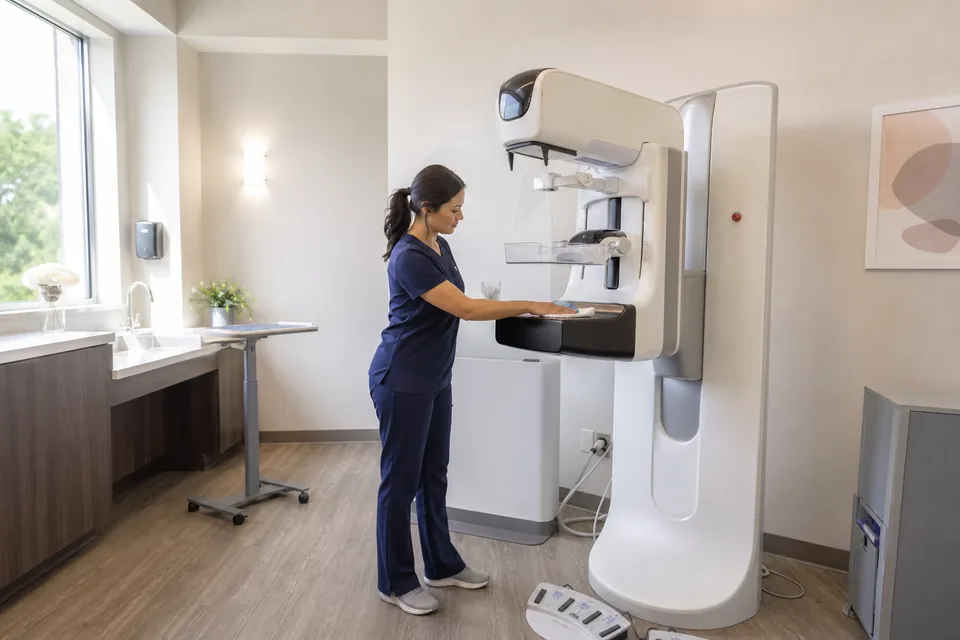
The short answer: MammoScreen is mammography and tomosynthesis detection software from Therapixel, a company in Nice, France, FDA-cleared since March 2020 and now on its fifth detection version. It scores each exam from 1 to 10 and marks suspicious regions. The FDA-cleared alternatives are ScreenPoint Transpara, Hologic Genius AI, Lunit INSIGHT, iCAD ProFound AI and DeepHealth Saige-Dx, and the right one depends mostly on your mammography units and who you are willing to buy from.
This page is for the person deciding whether to sign, renew or replace MammoScreen: the director of an independent imaging center, a hospital breast program manager, or the operator of a mobile or in-office mammography network. What ranks for MammoScreen today is Therapixel's own site, funding coverage and directory listings that mix it with thermal imaging startups. None of that tells you how it compares with the products you are actually choosing between, so we put the clearance record, the US distribution deals and the price evidence on one page.
Clearances come from the openFDA 510(k) database, product codes QDQ and QIH, queried October 8, 2026. Company and partnership facts come from Therapixel announcements and trade press (AuntMinnie, Tech.eu, Radiology Business). Federal figures are from USAspending.gov, award types A to D, fiscal 2008 to 2026.
Who makes MammoScreen and who sells it in the US?
Therapixel makes it. The company was founded in 2013, is based in Nice and is run by CEO Matthieu Leclerc-Chalvet. Its last announced round was a 15 million euro Series B in May 2022, led by Credit Mutuel Innovation and CapHorn, raised specifically to build out US sales and support. That matters to a buyer: it is a focused, venture-backed breast AI company, not a modality maker or an imaging center operator.
In the US, MammoScreen reaches sites three ways. Therapixel sells directly. It is available through AI marketplaces such as Ferrum Health (announced November 2021). And it is deployed through service partners, the largest being Onsite Women's Health, which said in April 2025 it would offer MammoScreen across its 150+ in-office breast imaging locations. If you heard about MammoScreen through one of those channels, the contract may not be with Therapixel at all, which changes who you negotiate with at renewal.
Is MammoScreen FDA cleared, and how does its record compare?
Yes, through the 510(k) pathway, which means substantial equivalence to an earlier device rather than proof of better outcomes. Therapixel holds seven clearances: five for detection and two for breast density. Here is how that record sits next to the products you are most likely comparing it with.
| Product | Company | First detection clearance | Latest detection clearance | Density product |
|---|---|---|---|---|
| MammoScreen | Therapixel (France, independent) | K192854, March 2020 | MammoScreen 5, K260714, June 26, 2026 | MammoScreen BD, K241561 (2024) and K243685 (2025) |
| Transpara | ScreenPoint Medical (Netherlands, independent) | K181704, November 2018 | K260898, August 14, 2026 | Transpara Density, K232096 (2023) |
| Genius AI Detection | Hologic | K201019, 2020 | Genius AI 2.0, K243341, July 2025 | Quantra |
| INSIGHT MMG and DBT | Lunit (Korea, owns Volpara) | K211678, 2021 | INSIGHT DBT 1.2, K253796, March 2026 | Volpara density |
| ProFound AI | iCAD, owned by RadNet since July 2025 | K182373, December 2018 | ProFound V4.0, K240417, November 2024 | PowerLook Density |
| Saige-Dx | DeepHealth, a RadNet company | K220105, 2022 | K253825, June 2026 | Saige-Density, K243705 |
MammoScreen's clearance history between 2024 and 2026 (versions 3, 4 and 5 plus two density clearances) is the busiest of any independent vendor in the group. The later versions added features Therapixel describes as use of prior exams, a case pre-check and pre-reporting. Ask for the clearance summary of the exact version you would install, because older contracts may still run version 2.
How much does MammoScreen cost?
Therapixel publishes no price, and we found no federal contract in its name: searches for Therapixel and MammoScreen as a recipient or in award descriptions return nothing for 2008 to 2026. So we will not quote a figure. What the public record does show is the scale of comparable purchases:
- The one federal order naming Transpara is a $44,944 Army order from August 2025 for a five-year license on a single Fujifilm unit, about $9,000 a year.
- Forty-two federal orders to iCAD since 2008 have a median of $16,206, mostly single-site support and license renewals.
- Some US clinics pass mammography AI to patients as an optional add-on. One Arizona imaging center charges $29 out of pocket for an AI review and states that insurers do not cover it.
If you run that patient add-on model, budget the admin work too: a $29 self-pay charge per exam turns into hundreds of small balances a month, and the clinics that keep it profitable are the ones that automate follow-up on small patient balances instead of chasing them by phone. For the commercial quote itself, ask Therapixel or your partner to itemize four things: the license unit (per site, per mammography unit or per study), annual support, integration with your PACS and reporting system, and whether 3D tomosynthesis is priced separately from 2D.
MammoScreen or Transpara for an independent breast center
These are the two products independent centers compare most often, because both come from focused, independent companies and both read 2D and 3D images from several unit makers. The honest differences are narrow.
| What to compare | MammoScreen | Transpara |
|---|---|---|
| Exam score | 1 to 10 likelihood score per exam, plus marked regions | 1 to 10 exam score, plus marks and on-demand region queries |
| Trial evidence | Reader studies supporting its clearances | The Swedish MASAI randomized trial, which reported 12% fewer interval cancers in The Lancet in January 2026 |
| How it reaches US sites | Direct, AI marketplaces, Onsite Women's Health network | Direct, and as an option on Siemens Healthineers and Fujifilm units |
| Public US price evidence | None found | One Army order, about $9,000 a year for one unit |
| Best fit | Centers that want an independent vendor and a partner channel with flexible deployment | Centers buying Siemens or Fujifilm units, or those that weigh randomized trial evidence most |
We cover Transpara in depth, including its full clearance list and the Fujifilm order, on Transpara alternatives and ScreenPoint Medical breast AI compared.
Which MammoScreen alternative fits which buyer?
All-Hologic fleet. Genius AI Detection ships with Hologic units and is the path of least integration. The trade-off is that detection, density and the hardware all come from one vendor, which reduces your leverage at renewal.
You want an independent vendor that runs no imaging centers. Since RadNet owns both iCAD and DeepHealth, an independent center competing with RadNet locally usually limits its shortlist to MammoScreen, Transpara and Lunit. Our page on iCAD ProFound AI alternatives explains what changed when RadNet bought iCAD.
You also want chest X-ray AI. Lunit sells INSIGHT CXR alongside its mammography products and owns Volpara for density and risk. See Lunit alternatives and, if density is the part up for renewal, Volpara alternatives.
Your problem is reading capacity, not detection. A detection product marks a region on one exam and stops. If the real constraint is how many studies each radiologist gets through across breast and general imaging, that is a different purchase.
What should I ask before renewing MammoScreen?
- Which version is installed? Version 5 (K260714) was cleared in June 2026. If you run version 2 or 3, ask whether the upgrade is included in support or sold as a new license.
- Who is the contract with? Therapixel, a marketplace or a service partner. Partner contracts can bundle MammoScreen with reading or staffing services, and unbundling it later is harder.
- What is the unit of price? Per site, per unit or per study changes your cost sharply as volume grows. Get it in writing for both 2D and 3D.
- What are your own numbers? Ask for recall rate, cancer detection rate and reading time before and after go-live at your own sites. Published studies are a starting point, not your result.
- What happens to your images? Ask whether exams or outcomes are used to train future versions and what the data terms say.
Can I keep MammoScreen and still speed up the read?
Yes. Detection and reading assistance sit side by side. Radiological.ai receives studies over standard DICOM, flags suspected findings for review across X-ray, CT, MRI and mammography, reorders the worklist so urgent studies come first and drafts the structured report. The radiologist reviews, edits and signs every study, and MammoScreen keeps running on the breast exams. Pricing is published per reading radiologist on the pricing page, and AI mammography software shows how the assistant handles a breast read. For MQSA audit and follow-up around the read, see mammography tracking software.
See Radiological.ai read a study
The assistant flags suspected findings for review, prioritizes the worklist so urgent studies surface first, and drafts the structured report into your template. You review, edit and sign every study.